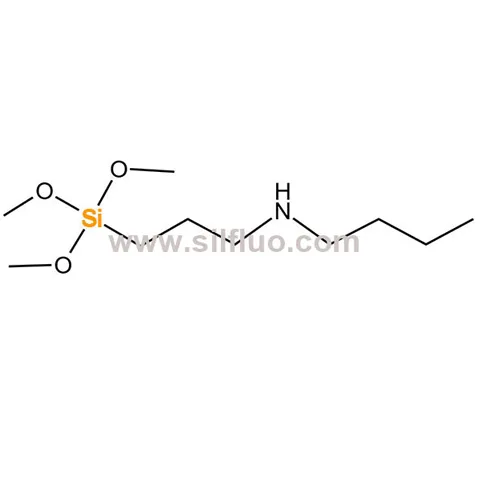
Typical Physical Properties of Silfluo LS-A431
Silfluo Code: | LS-A431 |
Chemical Name: Synonyms: | (3-(Trimethoxysilyl)propyl)butylamine; N-(n-Butyl)-3-aminopropyltrimethoxysilane; N-Butyl-3-aminopropyltrimethoxysilane; Secondary amino-functional trimethoxysilane |
CAS NO. | 31024-56-3 |
EINECS No.: | 250-437-8 |
Formula | C10H25NO3Si |
Appearance | Colorless to Pale Yellow Transparent Liquid |
Density(ρ20°C,g/cm³) | 0.947 |
Refractive Index( n 25°C ) | 1.4246 |
Purity (by GC,%) | 97 min |
Applications of Silfluo LS-A431
1. Adhesives and sealants
Used as adhesion promoter or reactive silane additive in polyurethane, silicone, MS polymer, SPUR, and hybrid adhesive or sealant systems. Verify adhesion, cure behavior, viscosity, and storage stability by formulation testing.
2. Coatings and primers
Used in epoxy, acrylic, polyurethane, and hybrid coating systems. Test wet adhesion, dry adhesion, corrosion resistance, and film compatibility in the target formulation.
3. Resin modification and foundry binders
Used in phenolic, furan, melamine, and other binder systems. Verify mechanical properties, moisture resistance, gas evolution, and processing behavior under customer process conditions.
4. Fiberglass composites
Used as sizing or surface treatment component for fiberglass fabrics and glass fiber-reinforced composite systems. Verify interfacial adhesion and composite properties in the target resin system.
5. Mineral filler treatment
Used for treating silica, ATH, talc, and other inorganic fillers. Verify dispersion, viscosity, mechanical properties, and processing behavior in the target compound.
6. Surface treatment and primers
Used in primer and surface treatment systems requiring secondary amine functionality and alkoxysilane reactivity. Verify adhesion and compatibility in the target system.
Formulation & Handling Guidelines of Silfluo LS-A431
1. Hydrolysis behavior
Methoxy groups hydrolyze in the presence of moisture to form silanol groups, releasing methanol. Hydrolysis rate and silanol stability depend on water content, pH, solvent, catalyst, and temperature.
2. Aqueous bath pH
The hydrolysate is typically alkaline. Adjust pH per target process and stability requirements. Verify bath stability before scale-up.
3. Solvent compatibility
The secondary amine reacts with carbonyl-containing solvents including MEK, acetone, and ethyl acetate. Test compatibility before use.
4. Moisture and CO₂ sensitivity
Amino-functional silanes react with moisture and atmospheric CO₂ during storage and handling. Keep containers tightly sealed and minimize air exposure after opening.
5. Handling after opening
Reseal containers promptly after dispensing. Dry nitrogen blanketing can be considered for moisture-sensitive applications.
6. Formulation testing
Verify cure behavior, adhesion, color stability, viscosity change, and storage stability in the complete formulation before commercial use.
Packaging of Silfluo LS-A431
In 20kg pail, 190kg drum and 950kg IBC
Safety and Storage of Silfluo LS-A431
Store in a cool, dry, well-ventilated environment. Keep away from direct sunlight, heat, sparks, and open flames.
Shelf life: 12 months from manufacture date when stored at ≤25°C in original tightly sealed unopened containers.
Verify product properties against specification before use if stored beyond the stated shelf life.
 English
 日本語
日本語 한국어
한국어 français
 Deutsch
 Español
 русский
 português
 العربية
 tiếng việt
 ไทย
ไทย