Typical Technical Properties of Low Hydrogen Silicone Fluid LF-H101L
Silfluo Code: | LF-H101L |
Chemical Name: Synonyms: | Methyl Hydrogen Silicone Fluid (Copolymer) Methylhydrogen-Dimethylsiloxane Copolymer; Low-H Silicone Oil |
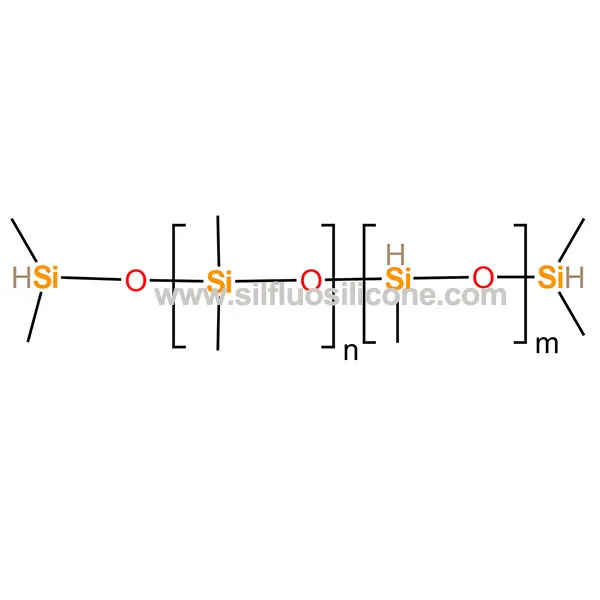
Molecular Formula: | (CH3)3SiO[(CH3)HSiO]n[(CH3)2SiO]nSi(CH3)3 |
Appearance: | Colorless transparent liquid |
CAS NO.: | 63148-57-2 |
Viscosity (25°C, mpa.s) | 10-1000 (can be customized) |
Hydrogen Content, wt% | 0.1 ~ 1.5 (can be customized) |
Density (25°C): | 0.98-1.00 |
Volatiles(%): | ≤1 |
pH Value | 6.0-7.0 |
Various viscosity and hydrogen can be customized.
Grade | Termini | Pendant Si-H | H Content | Network Topology | Primary Use |
LF-H101H | Trimethylsilyl | High density | ≥1.5 wt% | Dense 3D | LSR crosslinker; hydrophobing |
LF-H101L | Trimethylsilyl | Diluted | 0.1–1.5 wt% | Controlled density | Soft LSR; bulky grafting |
LF-H101S | Trimethylsilyl (methyl) | Pendant only | 0.03–1.2 wt% | Comb-type | Grafting backbone; PU foam stabilizer |
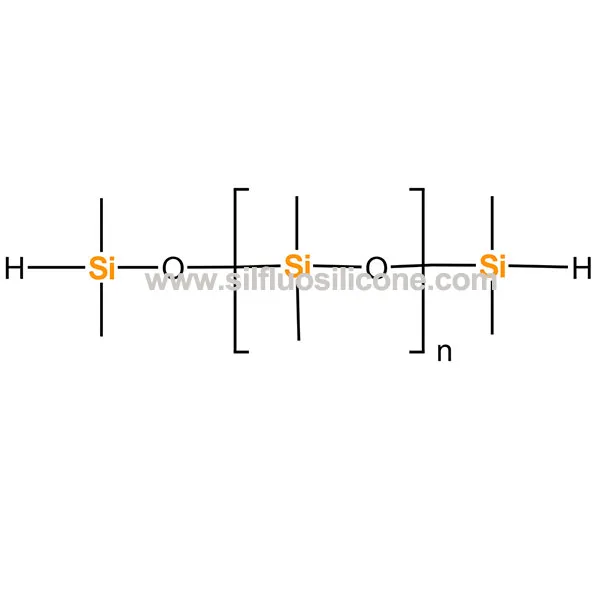
LF-H101T | Si-H terminated | None | 0.009–0.80 wt% | Linear extension | ABA block copolymer; chain extension |
LF-H101TS | Si-H terminated | Yes | 0.28–1.0 wt% | Terminal + pendant — combined | High-density fast-cure LSR; PSA; release coating |
Applications of Low Hydrogen Silicone Fluid LF-H101L
1. Controlled Crosslinker for Soft LSR and Silicone Encapsulants
Used as crosslinking agent in platinum-catalyzed addition-cure LSR and silicone encapsulant systems where reduced crosslink density is required to achieve higher elongation at break, lower hardness (Shore A), and improved tear strength compared to systems crosslinked with high-hydrogen PMHS. Si–H to vinyl ratio and hydrogen content selection determine the mechanical profile of the cured elastomer. Avoid contact with Pt catalyst inhibitors (sulfur, phosphorus, tin compounds, amines).
2. Synthetic Intermediate for Modified Silicone Fluids
Used as Si–H reactive backbone for synthesizing polyether-modified, epoxy-modified, and long-chain alkyl-modified silicone fluids via Pt-catalyzed hydrosilylation. Lower Si–H density reduces inter-site steric interference during grafting of bulky side chains (e.g., polyether or long alkyl groups), improving grafting efficiency and product uniformity relative to high-hydrogen PMHS.
3. Dry Powder Anti-Caking Treatment
Used as moisture-proof, anti-caking surface coating for dry chemical fire extinguishing powders. Controlled Si–H content provides sufficient surface hydrophobing while the copolymer backbone imparts flexibility to the treated powder particle coating, maintaining flowability and discharge performance under long-term storage.
4. Hydrophobing Agent for Construction and Industrial Substrates
Applied neat or in dilute solution to glass, ceramics, cement, marble, metals, and leather. Dehydrogenative condensation with surface hydroxyl groups under acid or metal salt catalysis deposits a hydrophobic siloxane film. Lower crosslink density of LF-H101L-derived films provides a more flexible coating layer suited to substrates that undergo dimensional change or flex in service. Ensure adequate ventilation — hydrogen gas is released during condensation with hydroxyl surfaces.
Package & Storage of Low Hydrogen Silicone Fluid LF-H101L
In 50kg, 200kg drum and 1000kg IBC.
Keep in cool, dry and ventilated place. Keep away from sunlight and fire sources. Keep in unopened containers, shelf life is 12 months from the date of production. It is shipped as non-hazardous substance.
Storage beyond the shelf life does not necessarily mean that the product is no longer usable. In this case however, the properties required for the intended use must be checked for quality assurance reasons.